
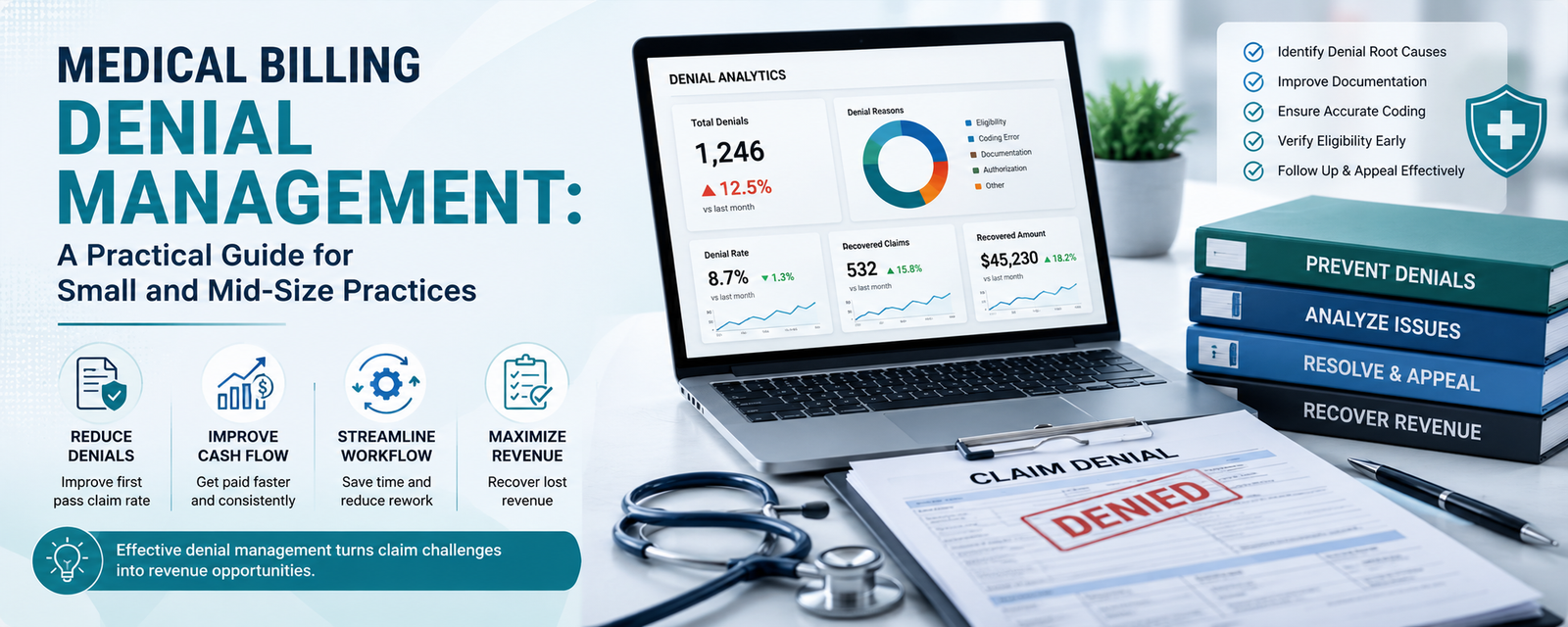
Medical Billing Denial Management: A Practical Guide for Small and Mid-Size Practices
Why Denial Management Matters More Than You Think
If you run a small or mid-size practice, a denied claim isn't just a paperwork problem — it's unpaid work. Every denial means staff time spent tracking it down, resubmitting it, and waiting again for a payer to respond. Industry estimates put average denial rates between 5% and 10% of submitted claims, and many practices never recover a meaningful share of that revenue simply because they don't have a system for chasing it down.
If you want the short version first — the specific mistakes causing most of those denials — see our companion post, , 7 Costly Medical Claim Denial Mistakes to Avoid. This guide goes a level deeper: the ongoing process for managing and preventing denials long-term.
Denial management is the structured process of identifying why claims are denied, fixing the root cause, resubmitting quickly, and — most importantly — preventing the same denial from happening again. Done well, it's less about disputing individual claims and more about closing the leaks in your revenue cycle before they cost you.
The Most Common Reasons Claims Get Denied
Most denials trace back to a small handful of recurring issues:
- Eligibility and coverage errors the patient’s insurance had lapsed, changed, or didn’t cover the service on the date billed.
- Missing or invalid prior authorization the payer required approval before the service, and it wasn’t on file.
- Coding mistakes incorrect or outdated CPT, ICD-10, or HCPCS codes, or a mismatch between diagnosis and procedure codes.
- Missing documentation the claim lacks the clinical notes or supporting detail a payer needs to process it.
- Duplicate claims the same service billed more than once, often from manual re-entry.
For a deeper breakdown of each of these with real examples, see 7 Costly Medical Claim Denial Mistakes to Avoid. Most of these are preventable. That's the difference between denial management (cleaning up after the fact) and denial prevention (stopping it before submission) — and the practices with the healthiest revenue cycles do both.
A Denial Management Process That Actually Works
1. Track denials by reason code, not just by claim
If you're not categorizing why claims are denied, you can't see the pattern. A practice that's losing money to eligibility errors needs a different fix than one losing money to coding errors.


2. Triage by dollar value and fixability
Not every denial is worth the same effort. Prioritize high-dollar claims and ones with a clear, fast fix appeal or resubmit those first, and don't let them age past the payer's resubmission window.
3. Fix the root cause, not just the claim
If the same denial reason keeps showing up, the fix belongs upstream at check-in, at coding, or in your prior-authorization workflow not in the billing department alone.
4. Resubmit fast
Denials aren't rejections; most are correctable. The longer a corrected claim sits, the more likely it is to slip past a filing deadline or simply get forgotten.
5. Report on it monthly
A simple denial rate by payer and by reason code, reviewed monthly, turns denial management from reactive firefighting into a trend you can actually improve.
When to Handle Denials In-House vs. Outsource
Smaller practices often start with denial management handled by front-desk or billing staff alongside their other duties — which works until claim volume grows or staff turnover leaves gaps in follow-up. The signs it's time to bring in dedicated help usually show up as a pattern: denials aging past 30 days without resubmission, the same denial reason recurring month over month, or collections staff spending more time on appeals than on new claims.
Outsourced revenue cycle management (RCM) partners specialize in exactly this tracking denials by reason, managing the appeals workload, and feeding what they learn back into coding and intake so the same denial doesn't happen twice. For a practice without the staff to run that loop consistently, it's often the fastest way to close the revenue gap without adding headcount. TruClaim RCM's medical billing services and medical coding services are both built around this kind of root-cause denial prevention.
A billing company charging a slightly higher percentage with a strong denial management track record will often put more net revenue in your pocket than a cheaper option with a high denial rate and no real appeals process. As a general benchmark, the Medical Group Management Association (MGMA) considers a net collection rate near 96% to be a healthy target — a useful number to compare against when a billing company shares their own performance data.
Dr. David Reynolds, MD
Orthopedic Surgeon
Every claim represents quality patient care. Accurate billing ensures that care is properly recognized and reimbursed.
Frequently Asked Questions
Get a Transparent Quote
At TruClaim RCM, we build pricing around your specialty and claim volume with no hidden add-on fees and no long-term lock-in contracts.

Medical Billing
Worldwide clients
