

How Long Does Medical Credentialing Take? A Realistic Timeline

The Short Answer

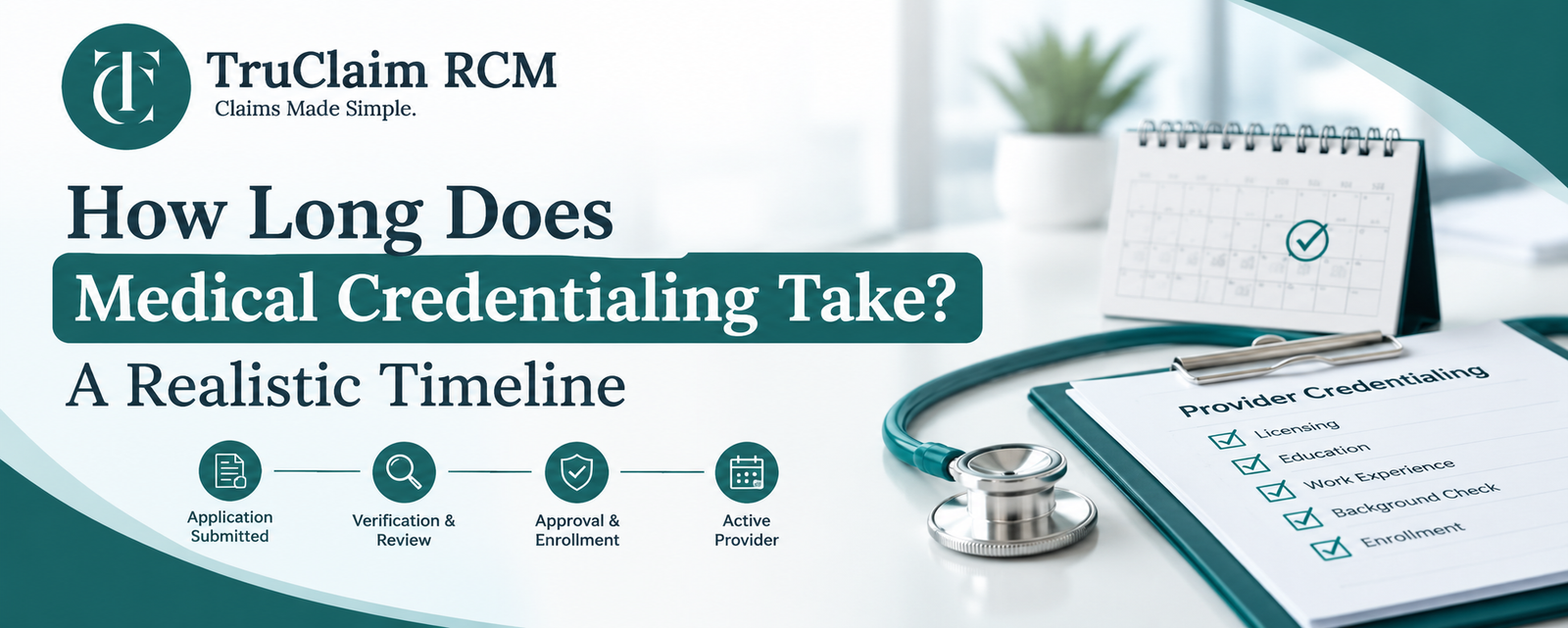
How long does medical credentialing take? Most providers should expect 60 to 180 days, with 90 to 120 days being the most common timeline across payers. Some payers move faster with a complete application; others, especially government payers like Medicare and Medicaid, can stretch closer to the 180-day end depending on backlog and documentation completeness.

When estimating how long does medical credentialing take, there's no single fixed number because credentialing timelines depend heavily on the payer, the provider's specialty, and — more than anything else — how complete the application is on first submission.

Credentialing Timeline, Step by Step

Weeks 1–2: Document collection

Gathering licenses, malpractice history, education verification, work history, and references. This step is entirely within the practice’s control, and delays here push back everything downstream.

Weeks 2–3: CAQH profile setup and attestation

Most payers pull from a completed CAQH ProView profile. An incomplete or un-attested profile is one of the most common reasons an application stalls before a payer even begins reviewing it.

Weeks 3–4: Application submission

Applications go out to each targeted payer. Some accept electronic submission; others still require mailed or faxed paperwork, which adds processing time.

Weeks 4–12+: Payer review and verification

The payer independently verifies education, licensure, malpractice history, and references this is typically the longest phase, and the one practices have the least direct control over.

Weeks 12–16+ (or longer)

Committee approval and confirmation: Many payers require final sign-off from a credentialing committee, which often meets on a fixed monthly or bi-monthly schedule rather than reviewing applications continuously this alone can add several weeks if an application narrowly misses a committee date.

how long does medical credentialing take

What Slows Credentialing Down

Delay Factor Impact & Description
Incomplete CAQH profiles Missing or unattested information is one of the most common causes of delay industry-wide.
Missing documentation Gaps in work history, expired licenses, or missing malpractice coverage details send applications back for correction.
Payer backlog Government payers and larger insurers with high application volume can take longer regardless of how complete your submission is.
No active follow-up An application sitting in a queue with no one checking its status can quietly stall for weeks longer than necessary.
Committee meeting schedules Missing a payer’s monthly credentialing committee cutoff by even a day can add another full month to the timeline.

How to Speed Up Credentialing

Knowing how long does medical credentialing take helps your practice plan ahead. Implement these proactive strategies to shorten the wait:

Best Practice Actionable Strategy & Impact
Start early Begin credentialing as soon as a provider is hired, not once they’re scheduled to see patients, since the process routinely takes 3+ months.
Keep CAQH fully current Re-attest on schedule rather than letting it lapse, which is one of the most preventable causes of delay.
Submit complete applications Get it right the first time — a single missing document can cost weeks in back-and-forth, far more time than getting it right upfront.
Track status proactively Don’t wait for payers to reach out; follow up on a set schedule so an application never sits idle.
Dedicated partner Consider a dedicated credentialing partner — this is exactly the kind of document-heavy, deadline-sensitive process that benefits from someone whose full-time job is tracking it, rather than a front-office staffer juggling it alongside other work.

A billing company charging a slightly higher percentage with a strong denial management track record will often put more net revenue in your pocket than a cheaper option with a high denial rate and no real appeals process. As a general benchmark, the Medical Group Management Association (MGMA) considers a net collection rate near 96% to be a healthy target — a useful number to compare against when a billing company shares their own performance data.

Dr. David Reynolds, MD

Orthopedic Surgeon

Every claim represents quality patient care. Accurate billing ensures that care is properly recognized and reimbursed.

Ask Question

Frequently Asked Questions

Some payers offer expedited timelines for urgent needs, but it's not universal — and a complete, error-free application submitted early is usually the single biggest lever a practice actually controls.

They're related but distinct — credentialing verifies a provider's qualifications and history, while enrollment is the process of actually being added to a payer's network to bill as in-network.

They can see patients, but billing in-network typically isn't possible until credentialing and enrollment are confirmed — seeing patients before that point risks claims being denied or the patient being billed out-of-network rates.

Take Control of Your Timeline

How long does medical credentialing take? Plan for 90 to 120 days on average, and budget closer to 180 for slower payers or complex specialties. The timeline is largely outside a practice’s control once an application is submitted — which is exactly why the parts that are controllable (complete documentation, an up-to-date CAQH profile, and consistent follow-up) matter so much.

Don’t want credentialing delays to hold up a new provider’s start date?

TruClaim RCM’s medical credentialing services manage the entire process, including follow-up, so applications don’t stall.

Leave A Comment